The Sword and the Shield: The Revolutionary Lives of Malcolm X and Martin Luther King Jr.
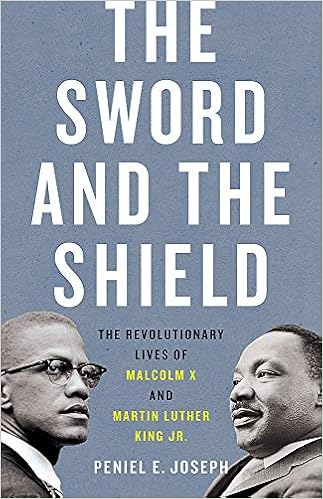
To most Americans, Malcolm X and Martin Luther King Jr. represent contrasting ideals: self-defense vs. nonviolence, black power vs. civil rights, the sword vs. the shield. The struggle for black freedom is wrought with the same contrasts. While nonviolent direct action is remembered as an unassailable part of American democracy, the movement's militancy is either vilified or erased outright. In The Sword and the Shield, Peniel E. Joseph upends these misconceptions and reveals a nuanced portrait of two men who, despite markedly different backgrounds, inspired and pushed each other throughout their adult lives. This is a strikingly revisionist biography, not only of Malcolm and Martin, but also of the movement and era they came to define.
Reviews (48)

Juxtaposition
This book juxtaposes MLK with Malcolm X and in doing so brings more clarity to the effectiveness of both by virtue of their almost symbiotic existence. I am one who has grown to admire how MLK maintained his commitment to peaceful direct action protests throughout his all too short life. I have also been curious about Malcolm X who made several serious transformations through his all too short life. As a white person, I have always been leery of Malcolm X as he is too often presented as an advocate of violence among races as a way to make progress. This book helped clarify for me that all is not as it seems. The implication is that MLK would not have been as effective with non-violence had there not been Malcolm X articulately legitimizing the likelihood that violence would be the only way to break the yoke of racism in our country. On the other side of the coin, it is unlikely Malcolm X would have made his final transformation without the example of MLK. The impact of both men is best exemplified in their attendance at the Senate hearings and brief encounter for the Civil Rights Act. Just having them both there likely kept the Senators focused. MLK's presence helped focus them that they either pass the bill and hope to avoid violence. Meanwhile, Malcolm X' presence helped them keep it real in the case that no bill passed. Reading this book during the tensions brought about by the police murder of George Floyd makes this book even more interesting. While MLK arguably got more done in his life with his approach, Malcolm X was the more prophetic as to whether or not passing civil rights legislation would mean the end of racism and related discontent.

Malcolm X ”..black America’s prosecuting attorney” & MLK Jr, “..the nation’s chief defense attorney”
As I was reading about the relationship between Martin & Malcolm, I began thinking about a binary star system (and my knowledge of celestial science is beyond limited, but work with me here). I envisioned these two giants of men spinning around each other, their action plans diverging greatly at the onset. Their gravitational fields - stronger than anything in the vicinity - pulled & pushed on each other and others close to them. Over time they became stronger, brighter, magnetic, and in the end, a sort of convergence of philosophy; almost identical. Even though they were in the same space, history has them meeting only once, but destiny has them linked together forever. Hopefully, The Sword and the Shield will have you in deep reflection as well. This is my third Peniel Joseph book on the shelf. I was waiting for the release of this book and it was worth the wait.

MUST READ!
This book is an outstanding contribution to African American history. Joseph brilliantly and deftly narrates the lives of two of the most important figures in the fight for global human rights. His work demonstrates that Malcolm and Martin were indeed more alike than dissimilar, and that their contributions have radically transformed our understandings of Black dignity and Black citizenship locally and abroad. Bravo Dr. Joseph!

Why Malcolm X and Martin Luther King are relevant today
The subtitle of Professor Joseph’s dual biography is “The Revolutionary Lives of Malcolm X and Martin Luther King Jr,” and the book’s goal is to demonstrate that King was more revolutionary and Malcolm more pragmatic than the general view of the two leaders. Given the current state of race relations in America, the book could not be more timely. Joseph is the Barbara Jordan Chair in Ethics and Political Values at the LBJ School of Public Affairs and is the founding director of the Center for the Study of Race and Democracy at the University of Texas at Austin. His five earlier books include The Black Power Movement: Rethinking the Civil Rights-Black Power Era; Waiting ‘til the Midnight Hour: A Narrative History of Black Power in America; and Dark Days, Bright Nights: From Black Power to Barack Obama. He acknowledges from the beginning that there were substantive differences between Malcolm and Kain, in the role of violence in organizing a political revolution and on the source of racial oppression. But a binary understanding of the men is incomplete. “Two-dimensional characterization of their activism, relationship, and influence,” he writes, “obscure how the substantive differences between them were often complimentary. It underestimates the way they influenced each other. And it shortchanges the political radicalism always inherent in each, even when they seemed to be reformist or reactionary.” After two short chapters sketching their backgrounds (“The Radical Dignity of Malcolm X” and “The Radical Citizenship of Martin Luther King”) Joseph spends the rest of the book on the ways in which the two reacted to, were affected by, and influenced the Civil Rights movement covering roughly the period 1954 (Brown vs. Board of Education) through February 1965 (Malcolm’s assassination) to April 1968 (King’s assassination). The Sword and the Shield could be read as a primer on how to effect social change. King in Birmingham, AL, advocating nonviolent resistance with rallies, meetings, and boycotts of downtown stores. Malcolm arguing that it was necessary to fight against police brutality. “President Kennedy,” said Malcolm, “did not send troops to Alabama when dogs were biting black babies. He then sent troops after the Negroes demonstrated their ability to defend themselves.” When an off-duty police lieutenant shot a 15-year-old black teenager in New York City in July 1964, protests erupted into a full-scale riot in Harlem. Martin went to the city in the temporary vacuum among black militants because Malcolm was in Africa. It was a fruitless. “Harlem exposed King to a deeper reality of institutional racism that made him better able to understand Malcolm X’s political rage, as well as the intractable forces that remained obstacles to the revolutionary changes that true justice required.” Readers who want a more complete portrait of Malcolm X should read Manning Marable’s Malcolm X: A Life of Reinvention. For the life of King, there is the three-volume biography and history of the Civil Rights movement: Parting the Waters, Pillar of Fire, and At Canaan’s Edge. I lived through the period The Sword and the Shield covers. I met King (my college newspaper held a fund-raiser for the SCLC) and lived in Harlem and I clearly recall the 1964 riot. Reading Joseph’s book, however, made me wonder if I were sleepwalking the entire time. So much I didn’t know. So much is new. So much is made clear. In his Epilogue, Joseph writes there is no way “to understand the history, struggle, and debate over race and democracy in contemporary America without understanding Malcolm X and Martin Luther King Jr.’s relationship to each other, to their own era, and, most crucially, to our time.” While the Civil Rights movement outlawed the worst of Jim Crow, America has managed to innovate “new forms of racial oppression in criminal justice, public schools, residential segregation, and poverty that scar much of the black community.” The Sword and the Shield puts an important period in American history and two key figures into context.

The Sword and The Shield
Dr. Peniel Joseph is an amazing writer and researcher. I love that he offers a lens on Malcolm X and MLK that we normally aren’t taught or shown. I learned so much from this book and plan to implement parts of it in my high school classroom.

Brilliant!
Smart, insightful, concise. If you think you know MLK and MX, think again. This book will challenge your understanding.

Insightful work and a pleasure to read.
I am a professional historian, but I don't work on the United States, so I was able to read this work both as a professional and as an amateur. I enjoyed it tremendously at both levels. As a historian, I admired the author's skillful storytelling, his effective use of primary sources and telling quotes, and the craftsmanship with which he pulled these two men's stories together into a single argument. I was also very much interested in the ways in which their careers and thinking were developed in tangent with wider international struggles. As an amateur, I'm not sure that this work fundamentally changed my understanding of either Malcolm X or Martin Luther King, Jr., but it certainly enriched my understanding tremendously. I also felt - and this was certainly intentional on the part of the author - that the work spoke directly to America's struggles with racial and social justice today. As a citizen, this was a powerful book to read. I did feel that the author brought Malcolm alive in a way that he did not with King, but this is a quibble, not a complaint. Note: I "read" this work as an audiobook. The voice actor for the audiobook did an absolutely amazing job.

Human Dignity: Viewed From, and Inflected By, Different Angles
Much of the history of anything we learn tends toward simplistic narratives and easy dichotomies. Nuance and complex intersections are either unseen or washed away. For a first-rate example of historical analysis that flouts these tendencies, you have no further to look than Peniel Joseph's "The Sword and the Shield": a well-researched, well-written, and balanced appraisal of the intersecting lives of Malcom X and Martin Luther King, Jr. Its basic thesis, argued with a gusto lacking in many historical reconstructions, is that we have too long pigeon-holed both of the seminal figures of the 1960s' Civil Rights Movement in the U.S.: Malcolm, the relentless advocate of "radical black dignity," taking arms for self-defense and black power; Martin, the equally tireless preacher of "radical black citizenship" whose touchstones were nonviolence and civil rights. Malcom, the sword; Martin, the shield. By tracing their respective family histories, religious influences, and class backgrounds, Joseph does not intend to meld these key figures into one. Their intellectual influences, world-views, and dispositions were very different. What Joseph demonstrates is the gradual yet genuine influence Malcolm and Martin exerted on each other. In the final years before their assassinations (respectively, 1965 and 1968), Joseph shows how Malcom's radicalism had been reshaped by Martin's pragmatism, and how Martin's own, differently inflected radicalism was becoming more revolutionary under Malcolm's influence. Joseph concludes, "Malcolm X and Martin Luther King, Jr., found common ground and a measure of unacknowledged political convergence through their respective advocacy of black dignity and black citizenship" (p. 313)—and that cross-pollination reverberates in America's political and racial turmoil to this day. If there be a deficiency in Joseph's analysis—here I speak as an amateur—it is that his source material for Malcolm runs out three years before King's. We may be unable to determine how far Malcolm, in his life's last year, would have made common cause with King. In the latter's case we have three years' more evidence, suggesting that King was moving more closely to Malcolm's critique of repressive capitalism and American imperialism in Viet Nam and elsewhere. Opening this book, I thought I knew something about its titular figures. By its end I realized I had, but my ignorance was vast. "The Sword and the Shield" is one of the best books of American history I have read in a long time. More important: it sets the record straight. Its epilogue's epigraph quotes James Baldwin: "I don't think that any black person can speak of Malcolm and Martin without wishing they were here." I'm a late middle-aged white person. Having read Peniel Jones's latest work, I feel the same.

An outstanding, must read novel.
A book that has taught me more about two black heroes and phenomenal leaders than I ever knew existed. At first glance, this book could be discerned as a delineation of two black, historical figures with flaws that almost outshined their righteous endeavors. However, after acknowledging the imperfect human natures that Malcolm X and Martin Luther King Jr. possessed in this book that, I was able to perceive the gravity that their presence and name brought to the global economy. They did not settle. They did not quit when hampered by friend or foe. They both equally believed in one's resolve to enliven a reality that would equalize a nation, and the world, for all to live freely, unbothered by the color of anyone’s skin. Complimenting and assisting the other on a journey that once appeared as opposition to the other, later distinguished an unbelievable dynamic force. Alive they fought for and, posthumously, achieved radical black dignity and citizenship for those rendered less than human, less than equal. Although the fight for equality continues in a myriad of ways, Malcolm X and Martin Luther King Jr. are both venerated and honored as exemplary, historical leaders.

Good scholarship, a must read for scholars or popular fans of either man.
Excellent book. Dr. Joseph treats both men with sensitivity to their lived truths as well as their popular and scholarly legacies. He offers penetrating insights and fresh analyses. This is a very useful addition to scholarship in the field.


Comments
Post a Comment